Blossom
Using Bingo to Facilitate Diverse Dynamics
Time:
Tools:
Type:
Role:
Team:
2023 - 2025
Figma, qua/quantitative research methods
Human Computer Interaction Research
Research&Design Lead
10+ (Irene, Researchers, Designers, Web Developers, PhD)


Overview
This project was with the Tech4Good lab, UC Santa Cruz with Professor David Lee, surrounding how to support dynamic interactions within community networking events. As the research lead for this project, aside from managing project deadlines, I mentored team members in design and research, lead the research writing, and designs for the study. This project went through two major study iterations.
This case study will introduce Blossom and then give an overview of the steps taken to get there during the different study iterations. Please reach out if you’d like to hear more about the project.
What is Blossom?
Blossom is a research project that looks at using technology to help facilitate the diverse goals and needs individuals have when attending networking events. People come into community/networking events wanting a variety of things: meet new people, find mentorship, talk about a niche interest, or just learn who else exists in their community.

By creating a personalized bingo board filled with icebreaking conversation starters or bingo prompts, event facilitators would be able to address the needs and wants of individuals.


During the event, attendees are given the bingo boards (mobile & physical paper) and are given general instructions to talk to new people and fill out their bingo board.

In addition to the mobile & physical bingo boards, there were activities on the whiteboards and screens to utilize the space.

Attendees were encouraged to add questions and ideas related to building community within the lab and alumni.

Screens were utilized to show the bingo boards and some responses that people had already submitted. All these prompts were derived from what the attendees of the event wanted to get out of the event.
Study 1: Conceptualization
The project first came to fruition because the professor wanted to find a way to engage 50-100 students from the same lab, but different research projects, during shared lab sessions. Through a literature review, the team was able to focus in on one high-level question:
How might we support the diverse needs and goals that individuals have when attending networking/community events?
Issues with existing work
Tended to focus on event-organizer goals rather than individual attendees
Did not break people up from their usual/comfortable cliques.
Lack of support in bridging attendees with those of higher “status” (e.g. more senior colleagues)
Scoping
From the literature reviews, I had then drafted some design options that the team would move forward with. The team had designed multiple options, but the designs I had created ended up being the ones used for the final iterations. Below are the designs that inspired the final design.


From there, the designers on the team continued working on the designs and I worked on finalizing the methods that would be used to create the bingo prompts.
Execution
There were a few rounds of testing prior to the actual execution of the study. The actual study that was reported in the paper had tested with 140+ students (research course & 2 lab meetings) and had ~15 interviews.

For this iteration, there was a digital screen in the event that was utilized to help display the bingo board for the entire group as well as show visualizations of different prompt responses and a leaderboard on what had been completed.

Results - Study 1
Through the interviews and survey results, I had found that attendees were able to achieve:
(1)A better sense of connection outside of their team
(2)Ability to leverage the potential of the community (sig diff between pre post)
“You were able to connect with different types of people, not just people that aligned with you through education, but also in your own hobbies.”
Study 2: The use of AI in facilitating in-person networking events
During the second iteration, the team had wanted to explore the role of generative AI in facilitation. There was little to no prior literature that looked at how AI can be used to facilitate networking events. Additionally, using AI would help with the customization of individual bingo boards for each attendee. As the events range in size, AI would also help with the scalability of the event.
Paper bingos were used instead of a digital screen to help reduce the friction that came from the figma prototype. (Originally, the bingo boards were supposed to be coded but they were not created in time for the studies.)


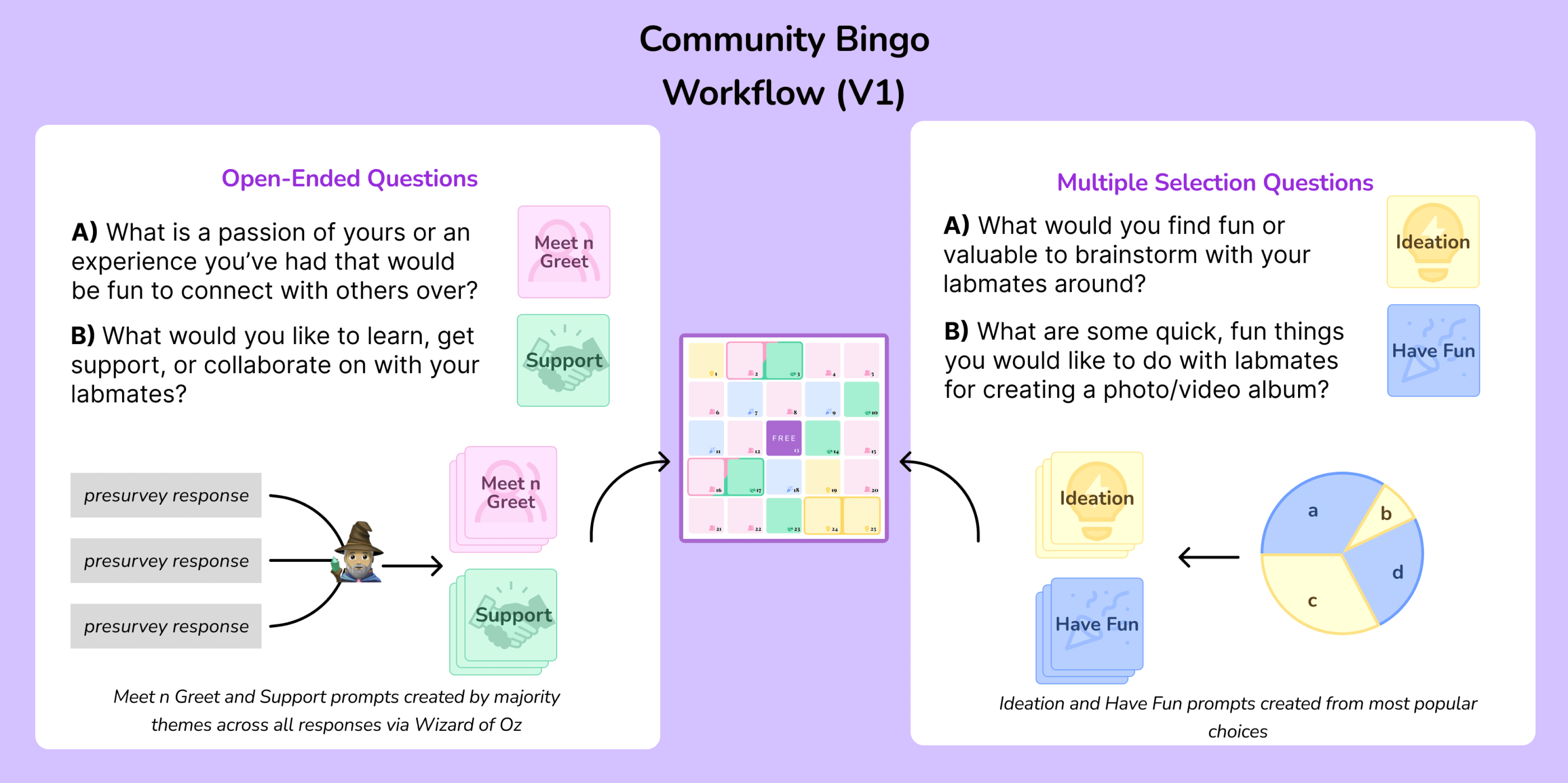
Bingo boards were generated through specifying which prompts would be customized through the use of AI and how they would be derived from survey responses.
This is the updated workflow from survey responses to bingo boards.

Results - Study 2
This study had 90+ attendees (a lab meeting + alumni reunion). Through another round of interviews and survey results, I had found that attendees were able to:
(1)Address very specific goals that they had set.
(2)Enjoyed the paper bingos as it allowed them to be present in the conversations.
21
Ask someone how to work towards a publication.
I want to work towards a publication. I am exploring full-stack development, but research sounds exciting.
“spoke to [PhD] and learned about it. He had a lot to say about research because he has a publication. So I just wanted to hear more of a perspective on it”
Personal Reflection
This project was something that I had worked on for half of my undergraduate career. I learned a lot on how to lead a team, how to conduct research, and how to mentor other aspiring designers and researchers while also being one myself. While this project didn’t end up getting published afterwards, the project does continue to be used within the lab, course, or alumni events for introductions. It was a really gratifying experience being able to work on a project that had a positive impact on people with their relationships with their classmates. This project had a lot fo quick iterations for a research project and the team had often come up with multiple design ideas within a week and different work flows that changed the day before the events.
Something that I would like this project to explore in the future would be working on the AI generation of the bingo prompts to be better at matchmaking attendees to each other.
thank you for visiting ~